

Someone nearby is tapping their toe. Is this an irritating noise or a musical sound? As it turns out, the difference depends almost entirely upon the listener.
The best indicator we have of knowing whether a particular person will interpret a sound as noisy or musical is their age. Since human hearing deteriorates over time, it becomes harder to hear "conversational" sound frequencies as we get older. Conversation is in the mid-range of our hearing — not super high and not super low — and so it can blend in with other environmental sounds and make the world sound more irregular and unpleasant. If someone is singing (making music) but there's an air conditioner sound in the background, the singing might get interpreted as noise.
source Education.com
Obviously, some sounds are more musical than others. Musical instruments, for example, produce sound waves that are ordered and regular.
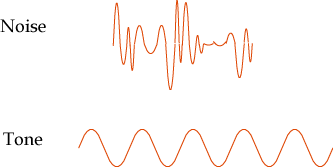
pictured: a chaotic-looking noisy sound wave and a well-order music sound wave
Music is composed of sounds with a fundamental frequency and overtones. Noise is composed of sounds with frequencies that range continuously in value from as low as you can hear to as high as you can hear — not necessarily at equal intensity, however. Music is described mathematically by an infinite sum of sines and cosines multiplied by appropriately valued coefficients — infinite mathematically, but in practice only a handful of overtones really matter. Noise is described by a spectral power distribution (or power spectrum), much like the statistical distributions of kinetic molecular theory. Music is ordered. Noise is random.
Essentially, the more “ordered” a sound is, the closer it is to being true music. The more disordered, the closer to noise. A more philosophical way to think of this distinction would be the level of beauty in the sound. A dissonant chord, meaning notes played together that do not sound harmonious together, naturally sound more like noise. But when this dissonant sound is followed closely by a consonant or pleasing sound, this gives us the structure for beautiful music.
The further we delve into displeasing or “dissonant” music, the more likely it is to be perceived as noise. Ultimately the line between the two is very blurry, and while we may be able to easily identify static on the television as noise and a trumpet as music, there are so many sounds in between that can fall into either category. It comes down to the amount of order and disorder that you can handle in what you listen to. For example, take a listen to the Noise Music below and see what you think. As the saying goes, beauty — or in this case, music — is in the ears of the beholder.
Added 6/4/2026:
What are the similarities between music and noise?
Both are a "sound," which means they are composed of physical waves that move the eardrum. "Noises" can still be somewhat ordered, such as the hum of a refrigerator or the rhythm of a washing machine, which can lead noises to be perceived as music. And in turn, music can also become "noisy" the more disordered it is — notes that sound unpleasant or do not have a steady rhythm become more noisy.
Want to make your own music?

Teach yourself guitar with our new instruction book! Available in Paperback and eBook